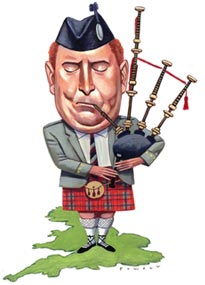
The Scot, which in the British imagination is a bluff and mumbling fellow, may seem like an unusual object of fear and loathing. But in London, it seems the city is being ruled over by a group of ambitious Scots—what Jeremy Paxman, a popular BBC presenter, has dubbed the "Scottish Raj." Prime Minister Tony Blair, who claims Englishness, was born and educated in Edinburgh. Five of Blair's 20 Cabinet ministers are Scottish, meaning that about one-twelfth of Great Britain's population has produced one-quarter of its Cabinet. The ruling Scots include Gordon Brown, who will probably succeed Blair as prime minister, and John Reid, the home secretary, Brown's only real rival for the post. Menzies Campbell, the leader of Britain's Liberal Democrats, is Scottish, as is his predecessor, Charles Kennedy.
Thursday, October 19, 2006
Scots Invading England!
"The Trick is to Keep Breathing" -- the Video
Janice Galloway Web
There is a riot of information at the Janice Galloway homepage -- both specific to the author and general on Scottishness .
Wednesday, October 18, 2006
Monday, October 16, 2006
Tuesday: Reminder on McIlvanney text
Just to remind you to as mentioned Thursday to bring your Laidlaw text to class one more time tomorrow....
Laidlaw
First off -- I called the British Consulate and asked the Deputy British Consul-General in Vancouver, audibly Scots Mr. Andy Newlands, for the correct pronunciation of the Laidlaw author's name. He supported classfellow K.'s "M'cILLvanney -- but not because of the "Mc" versus "Mac", but rather the double "N". The alternative spelling "McIllvaney" is pronounced MACillVNy.
Update: But stop the presses -- a Scots old-timer here has just told me that William McIlvanney was writer-in-residence here in the early nineteen-eighties, and the pronuciation is MACillVNy.
Update II: Our Department's Scottish Studies expert, Dr. Leith Davis, confirms MACillVANy.
Second, great work last Tuesday identifying so many of the elements of Laidlaw that deliberately set it in the American crime genre.
- harsh, sparse and colloquial prose.
- Smart Cop set against Stupid System
- an underworld setting.
- fascination bordering on glorification of Mobbery.
- wise but jaded senior cop partnered with callow rookie.
- unconventional and individualist detective techniques prevail (originating in Dostoevsky but known popularly as the Columbo model)
Add any additional tropes in the comments section ....
Franco-Scots Creation of .....America?
As presented in lecture, one claim of the continentalist side of present-day Scottish Studies (c.f. the Michael Gardiner essay or book) is the importance of France in Scotland in the creation of America. The Eighteenth century French writer formative in the developing idea of the American democratic model -- whose name escaped me in the ex tempore part of last lecture was Alexis de Tocqueville.
Saturday, October 14, 2006
Mid-Term Deadline Extension
Yes, that's right -- I have been, shall we say, encouraged to extend the deadline for the mid-term essay until the Tuesday: that is, October 24th in class. Best wishes!
Friday, October 13, 2006
"Always the Women"
A one-woman play being performed at SFU Harbour Centre in the Fletcher Challenge Theatre looks to give a corrective to John Knox's warped portrayal of women in the Bible.
Always theWomen with Nina Thiel, Saturday, October 21st, 8:00 pm, $5 per ticket -- "a solo performance of Jesus' encounter with women in the gospels."There are posters of the play with strong reviewers' comments in the English Department .
Tuesday's Class Location
As stated in Thursday lecture, for class on Tuesday October 17th we will convene in Special Collections at the W.A.C. Bennett Library on the Seventh Floor. Librarian Anthony Power will give a talk on our collection of books by Scots writer (and Monster) Alexander Whitelaw Robertson Trocchi.
So, see you in Special Collections this coming Tuesday at three-thirty.
Wednesday, October 11, 2006
"SuperGran" is In ....
Update: Great news: our new Media Collections Room in the W.A.C. Bennett Library has a Multi-region VCR player. Go to the media Collections desk, sign out the video, take it station #4, and sit back & chuckle at Scottishness for a spare half hour.
Supergran is a Scots cult classic, (Billy Connolly wrote & performs the theme song) and affords North Americans an entertaining, hilarious & quite plausible entre to Scottishness. Worth a half hour!
"Laidlaw" Social Context: 1977
Update: The Filth & the Fury is avaliable on Loan from the Bennett Librray
McIlvanney set Laidlaw in the specific social situation in Britain in the mid- to late- nineteen seventies: the publishing year is 1977. The clip seen from Johnny Rotten's video autobiography of the Sex Pistols, The Filth & the Fury, shows the deteriorated condition of Britain -- as Laidlaw describes the cities, "....Just architectural dumps where they unloaded the people like slurry."
This was the state of life in the U.K. that gave rise to both Punk Rock and Thatcherism. John Lydon (aka Johnny Rotten) makes this point directly in "The Filth & the Fury," showing the first image of Margaret Thatcher with the voice-over, "People had had enough." (Lydon's point in the opening sequence is his statement that "the Labour Party, which had promised so much after the War, had done so little for the working class," over clips of Heath & Wilson successively.)
This has to be kept clear for any useful understanding of modern British literary history (i.e. my specialty!). Punk Rock was not a response to Thatcher: they were both responses to the same social condition -- neither Punk nor Thatcherism would have existed without the state of affairs in Britain that conceived them both. The chronology makes Rotten's point more clearly -- especially for North Americans & those who were not there (as, ahem, I was ....)
Margaret Thatcher came to power in the middle -- May -- of 1979. Laidlaw was published in 1977, & presumably written in 1976. Punk Rock was effectively finished by 1979. (It softened into New Wave. What is marketed as 'Punk' today is smooth up-tempo pop.) Here's Johnny Rotten from No Irish, No Blacks, No Dogs:
(ps: From the landscape in Laidlaw, I'm taking that Punk reached Scotland at about a eight- to twelve- month lag from London.)
McIlvanney set Laidlaw in the specific social situation in Britain in the mid- to late- nineteen seventies: the publishing year is 1977. The clip seen from Johnny Rotten's video autobiography of the Sex Pistols, The Filth & the Fury, shows the deteriorated condition of Britain -- as Laidlaw describes the cities, "....Just architectural dumps where they unloaded the people like slurry."
This was the state of life in the U.K. that gave rise to both Punk Rock and Thatcherism. John Lydon (aka Johnny Rotten) makes this point directly in "The Filth & the Fury," showing the first image of Margaret Thatcher with the voice-over, "People had had enough." (Lydon's point in the opening sequence is his statement that "the Labour Party, which had promised so much after the War, had done so little for the working class," over clips of Heath & Wilson successively.)
This has to be kept clear for any useful understanding of modern British literary history (i.e. my specialty!). Punk Rock was not a response to Thatcher: they were both responses to the same social condition -- neither Punk nor Thatcherism would have existed without the state of affairs in Britain that conceived them both. The chronology makes Rotten's point more clearly -- especially for North Americans & those who were not there (as, ahem, I was ....)
Margaret Thatcher came to power in the middle -- May -- of 1979. Laidlaw was published in 1977, & presumably written in 1976. Punk Rock was effectively finished by 1979. (It softened into New Wave. What is marketed as 'Punk' today is smooth up-tempo pop.) Here's Johnny Rotten from No Irish, No Blacks, No Dogs:
By 1978 the masses of Great Britain had woke up to “Punk”, but it had become a tired cliche for third rate pub bands and chancers.We do the facts here, and analyse the literature accordingly.
(ps: From the landscape in Laidlaw, I'm taking that Punk reached Scotland at about a eight- to twelve- month lag from London.)
Sunday, October 08, 2006
Scotland & France: The lastest ....
Like any love affair, the relationship between Picts & Gauls has its moments. In this article, the French national football team manager credits the Scot ball boys for this weekend's defeat of France [!] -- but also can't resist including a word of love....
But I was disappointed with the attitude of the ball boys who slowed the game down whenever the ball went out of play. That was very disappointing for me from a country known for their fair play."
Friday, October 06, 2006
Tips on Reading the Deleuze Text
Gilles Deleuze, whose Empiricism and Subjectivity : an Essay on Hume's Theory of Human Nature is on course reserve as part of the background critical reading, is a continental (read, pâce Liz Lochhead "frenchified") literary theorist (his sometime attribution "philosopher" should, for our purposes, be read as an honourific, or an omnivorous generalisation.) How should monsieur Deleuze's essay be read?
For myself, I prefer to read literary theorists literarily (not, observe, literally) - that is, I expect delights. If the author fails to present these to me in a reasonable space, I then start to skim for nuggets. Should you happen not to find the writing of M. Deleuze to be deep, systematic, lucid & inviting, then simply ensure that you have the sense of the translator's Introduction, chapters one and six, and the conclusion.
Thursday, October 05, 2006
Mid Term Essay Topics
Update: some browsers apparently could not originally display all the format in this post. Adjustments made accordingly.
The criteria for the mid-term essay are detailed in the syllabus. The three topics are as follows. Write on one topic only.
1.] Develop a unified theory of the literary relevancy of the use of dialect Scots by Spark, Lochhead & McIlvanney. Concentrate your argument on direct textual analysis.
2.] It is argued that John Knox and David Hume represent a dynamic opposition at the foundation of contemporary Scottish literature. Using your own understanding of the essential characteristic of Scottishness, analyse how this putative opposition functions in literary terms in any two of the primary course texts.
3.] Textually analyse the matriarchies represented in Liz Lochhead's Mary Queen of Scots Got Her Head Chopped Off and Muriel Spark's The Prime of Miss Jean Brodie in terms of the continentalist theory of Scottish Studies.
Wednesday, October 04, 2006
On Handing in Assignments
The following circular has just been distributed to all of us from On High concerning the handing in of assignments. Note that, as specified on the syllabus, our assignments are either handed in during class or placed into my Department mailbox which is open 24/7/365.
.....procedures regarding assignments handed in outside of class. The new procedure is as follows: Department staff do not date stamp assignments handed in outside of regular class time; nor does the General Office any longer maintain a sign-in procedure for such assignments. Instructors are therefore strongly advised to have students hand in all assignments during class meeting times, or during their office hours. Please do not encourage your students to slip papers under your office door.
Office for Hours
In response to a question, my office (AQ6094) is on the north-west quadrant of the Academic Quadrangle, sixth floor, facing toward the quadrangle interior.
Question on Individual Presentations
I am receiving some questions about the Individual Presentations, and I want to re-iterate to everyone that the full criteria are in the Course Syllabus.
When you are researching and designing your presentation, it is my recommendation that you read the syllabus closely and near the middle and just before the end and verify that each and every criterion is fully & properly met in your project.
For instance, one criterion states that the presentation must be "....related to the Scottish background." This, then, openly entails the foreground -- which is obviously the course texts -- and the canny presenter will build his or her presentation with this syllabus fact in mind.
Lastly, do rest assured that the assignment grading has accomodated the efforts of the early presenters who have first broken the hard ground (or some rude Scots equivalent phrasing.)
"Rob Roy" and Whisky
Following from yesterday's Individual Presentation, here are sections from Sir Walter Scott's deutero-canonical Rob Roy ("Volume Two, Chapter Twelfth") I have alluded to on whishky (the mis-spelling is pointedly done.) I have emboldened some noteworthy text:
This explaineth much!
Each of the Highlanders had their naked dirks stuck upright in the board beside him,—an emblem, I was afterwards informed, but surely a strange one, that their computation was not to be interrupted by any brawl. A mighty pewter measure, containing about an English quart of usquebaugh, a liquor nearly as strong as brandy, which the Highlanders distil from malt, and drink undiluted in excessive quantities, was placed before these worthies. A broken glass, with a wooden foot, served as a drinking cup to the whole party, and circulated with a rapidity, which, considering the potency of the liquor, seemed absolutely marvellous.
I hae had chappins eneugh," said Inverashalloch; "I'll drink my quart of usquebaugh or brandy wi' ony honest fellow, but the deil a drap mair when I hae wark to do in the morning. [!!]
This explaineth much!
Tuesday, October 03, 2006
New "Pertinent & Impertinent" Links
You will see that I have added links to the Pertinent & Impertinent list (top of the blog to the right-hand-side) to the course syllabus, group field-school project, and individual presentations posts. This way they will always be visible & clickable for you at the top of the blog.
Subscribe to:
Posts (Atom)